

LED Light Bars in New Zealand: WOF Rules, Legality and Buying Guide
Selecting the right LED light bar comes down to two things: what’s legal to fit and use in New Zealand, and what actually puts light where you need it. This guide covers both, using NZTA’s current rules rather than guesswork.
LED Light Bars – The quick facts
Most LED light bars sold in New Zealand cannot legally be used as headlamps, and that isn’t a marketing opinion — it follows directly from NZTA’s rules.
A light bar can only be a headlamp if it’s fitted as a pair and carries an approved standards marking — a circled “E”, a boxed “e”, or “DOT” — on the lens. A single centre-mounted bar can never be a headlamp, no matter how good it is.
- Everything else is a work lamp. Work lamps are legal to fit and legal to own. They must be switched independently of your other lights, must not be wired into your headlamps, and may only be used when the vehicle is stationary or moving slowly to light up a work area — not for normal driving on a public road.
- Get the wiring right and your light bar passes a WOF. Get it wrong and it’s a fail.
- Source line, small text: Source: NZTA Technical Bulletin 14: LED light bars, VIRM In-service certification (WoF and CoF).
Are LED light bars legal in New Zealand?
Yes — but how you fit and wire them decides whether your vehicle passes its WOF.
NZTA puts every light bar into one of two categories. There is no third option, and the category isn’t something you choose. It’s determined by what the lamp is and how it’s installed.
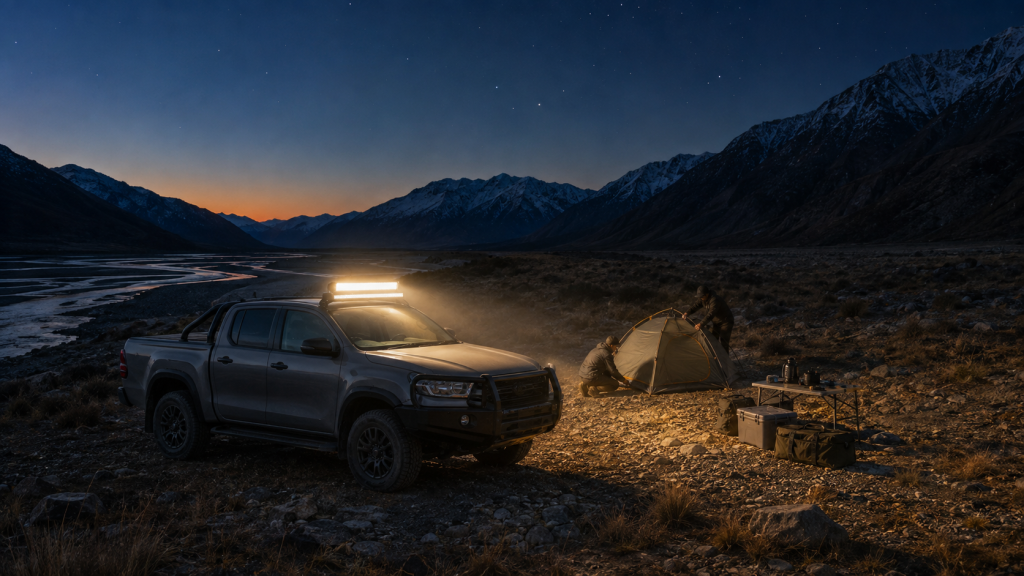
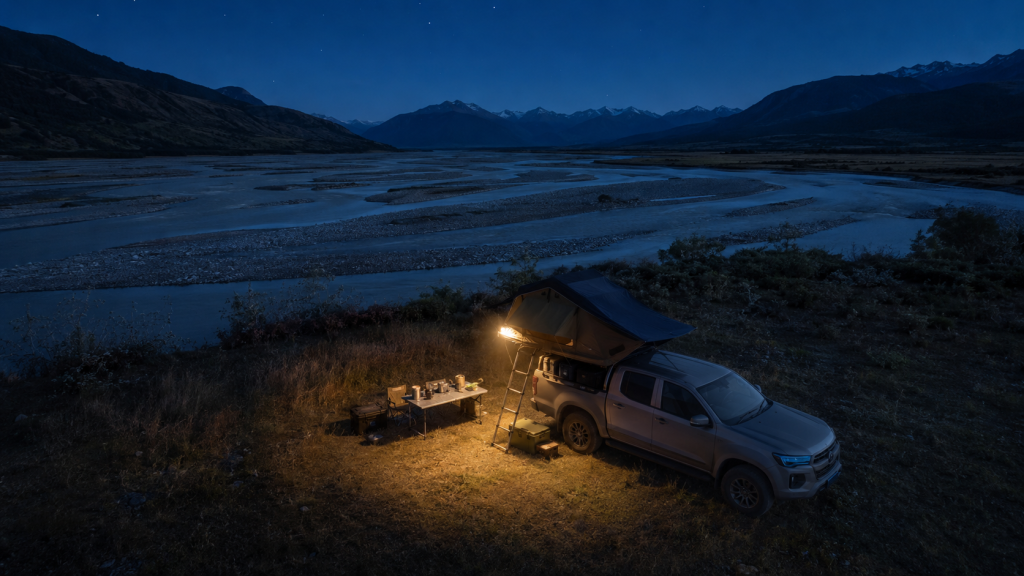
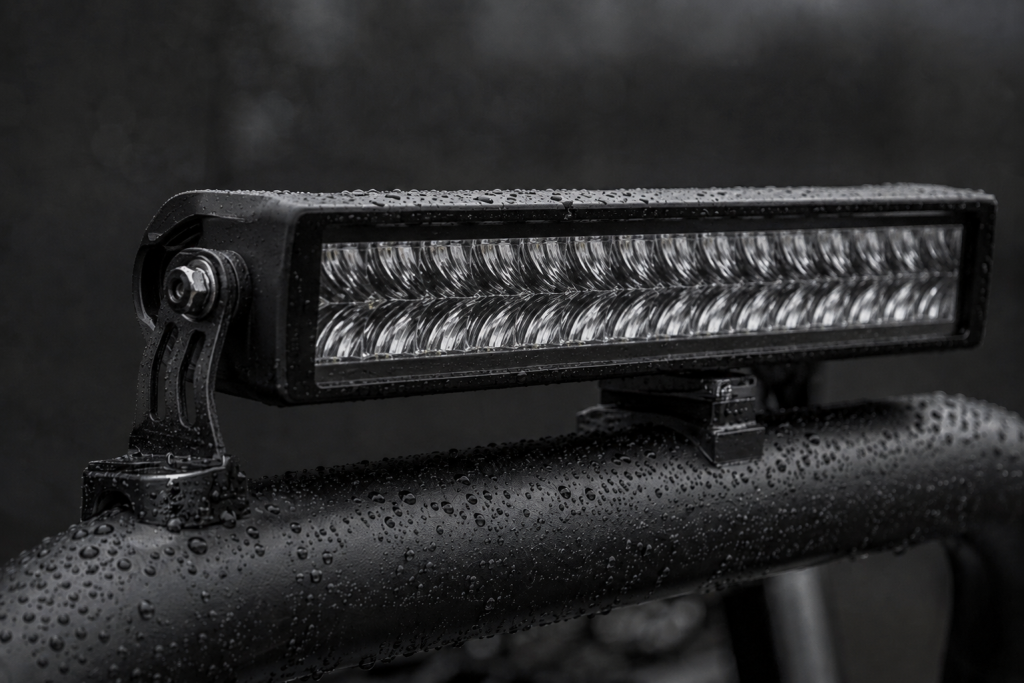
led light bars Fitted as a headlamp
To be treated as a headlamp, a LED light bar has to clear every one of these:
It must be fitted as a pair. On cars and trucks, all headlamps must be fitted in pairs. A single centre-mounted light bar cannot be considered a headlamp.
- It can only be a main beam, never a dipped beam. Vehicles are allowed one pair of dipped-beam headlamps and up to two pairs of main-beam headlamps. Your vehicle already has OEM dipped beams, so a light bar can’t be added as a second dipped-beam pair.
- It must carry an approved standards marking. Look on the lens for a circle containing a capital “E” followed by a number, a rectangle containing a lowercase “e” followed by a number, or the letters “DOT”. The number doesn’t matter. NZTA notes it isn’t aware of any of these lamps carrying Japanese standards compliance.
- It must not dazzle, confuse or distract other road users in a way that endangers safety.
- Aim matters. The centre of the beam pattern must point horizontally or downward — never up — and to the centre or left, never to the right.
- It must be dippable. Main beams must still be able to be dipped or extinguished from the driver’s seat.
- NZTA’s own note on this is blunt: because many light bars on the New Zealand market don’t comply with approved standards for headlamps, they can’t be fitted as headlamps.
If there are no standards markings on the lens, the lamp is likely non-compliant. NZTA states it isn’t aware of any compliant light bars without standards markings currently on the market.
led light bars Fitted as a work lamp
This is where the overwhelming majority of LED light bars land, including bars that are standards compliant but are fitted as a single unit.
NZTA defines a work lamp as a high-intensity lamp that isn’t necessary for operating the vehicle but is designed to illuminate a work area or scene — including scene lamps, spot lamps and alley lamps.
The rules:
Any vehicle other than a moped may be fitted with one or more work lamps.
- A work lamp must not be wired into the headlamps. It has to be switched to operate independently of all other lighting equipment.
- It’s not for normal on-road driving. Work lamps may only be used when the vehicle is stationary or travelling slowly, and only to illuminate a work area or scene.
- A work lamp doesn’t need to meet a lighting standard, because it’s for off-road use only.
- A work lamp can’t be fitted to a moped.
What happens at your WOF
The inspector works through it in this order:
- Does the lamp carry an E-mark, e-mark or DOT marking? If yes, it can be accepted as standards compliant. If there are no markings, it’s likely non-compliant.
- If it’s compliant and fitted as a pair, it can be treated as a main-beam headlamp, provided the aim, dipping and dazzle requirements are also met.
- If it’s non-compliant, or compliant but fitted as a single lamp, it may be classified as a work lamp — but only if it’s switched independently of all other lighting equipment. The inspector should advise the owner that using it for normal on-road driving is illegal.
- If it’s non-compliant and doesn’t meet the work lamp criteria, it must be failed.
That fourth outcome is almost always a wiring problem, and it’s almost always avoidable. A non-compliant bar spliced into your high beam circuit is a fail. The same bar on its own switch is a pass.
Two LED Light Bar myths
“There’s a lumen limit in New Zealand.” NZTA’s technical bulletin sets no lumen cap. The tests are standards compliance, correct pairing, correct aim, independent switching, and whether the lamp dazzles other road users. A 16,000-lumen bar wired correctly as a work lamp is fine. A 3,000-lumen bar wired into your high beams without markings is not.
“Covering the bar makes it legal to drive with.” A cover isn’t mentioned anywhere in the bulletin as a compliance mechanism. What determines legality is the marking, the pairing and the wiring. What determines legal use is whether you’re stationary or moving slowly and lighting a work area.
Callout box: Before you fit anything: check the lens for markings, decide up front whether you’re fitting as a work lamp or attempting a compliant headlamp pair, and wire accordingly. If you’re unsure, ask your WOF inspector before you drill. Rules can change — always check the current NZTA bulletin.
What this means when you’re buying your led light bars
Three practical consequences most retailers won’t tell you:
A pair beats a single bar if compliance matters to you. A single centre-mounted LED light bar can only ever be a work lamp. If you want the option of a legal main-beam setup, you need a standards-marked pair.
Ask about markings before you buy. If a listing doesn’t say whether the lamp carries an E-mark or DOT marking, ask. It’s the single most important compliance fact about the product and it costs the seller nothing to answer.
Budget for the switch. Independent switching isn’t optional for a work lamp — it’s the thing that makes the difference between a pass and a fail. Factor a switch and relay into the cost of the job, not just the lamp.
How to choose a LED light bar
Beam pattern
- Spot / pencil — narrow and long. Distance down the road. Poor peripheral fill.
- Flood — wide and short. Camp, reversing, work areas, tight tracks.
- Hybrid / combo — a blend. Best all-rounder for touring, and what most 4WD buyers actually want.
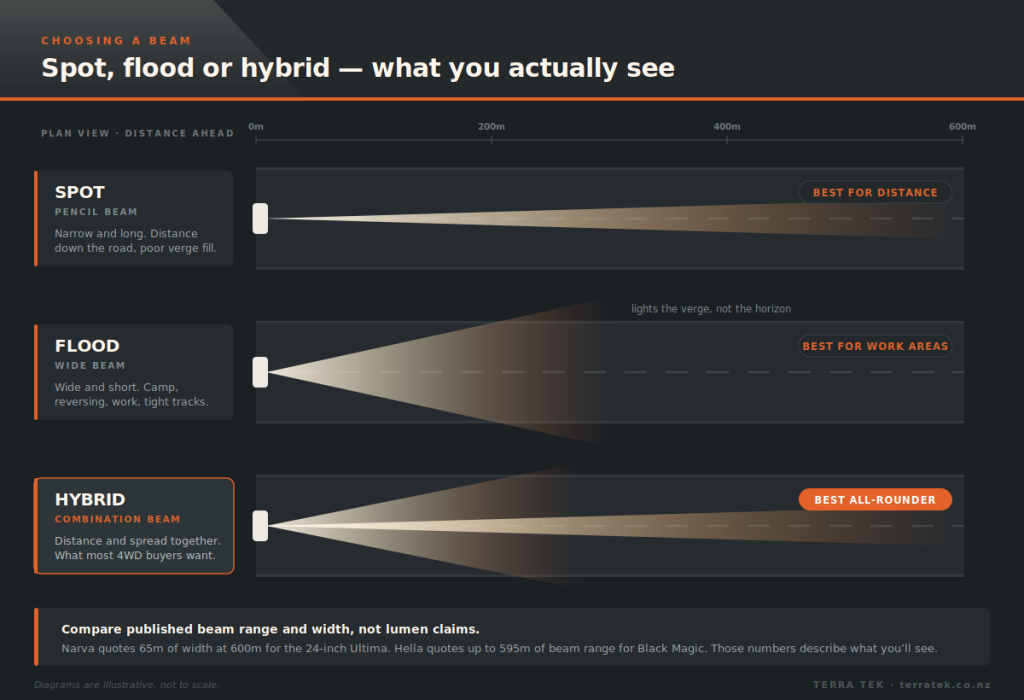
A common mistake is buying pure spot for general off-road use and then being unable to see the edges of the track.
Raw lumens versus effective lumens
This is where lumen figures get slippery.
Raw lumens is the theoretical output of the LED chips before any losses through optics, lens and housing. Effective lumens is what actually leaves the lamp. The gap is large — often 35–40%.
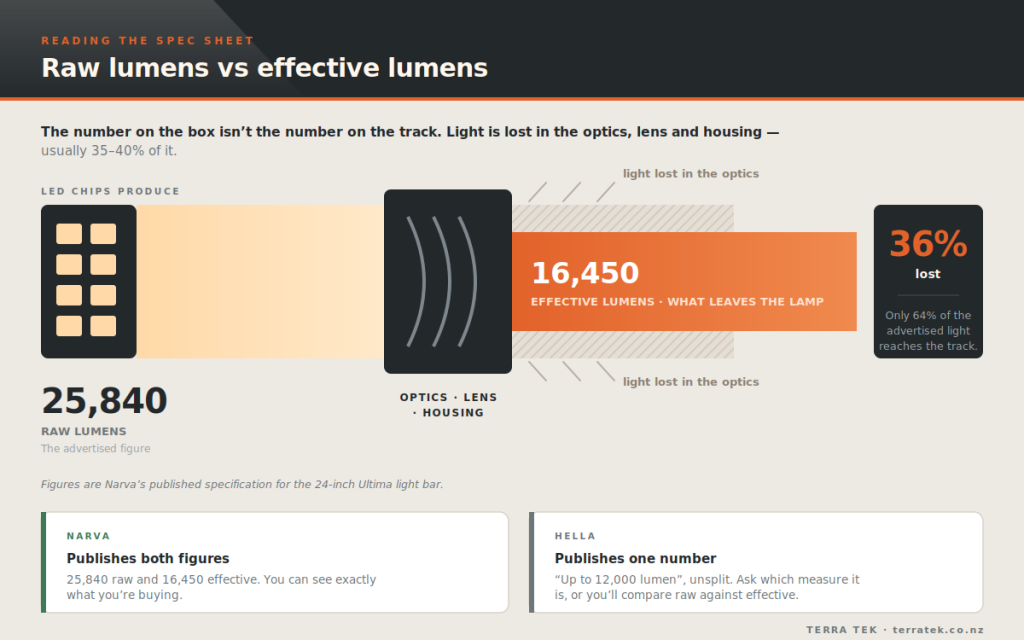
Narva publishes both figures. Their 24-inch Ultima is quoted as 25,840 raw and 16,450 effective. That transparency is worth something.
Hella quotes a single figure of up to 12,000 lumens for the Black Magic range and doesn’t split it. If you’re comparing across brands, ask which measure you’re looking at, or you’ll compare a raw number against an effective one and reach the wrong conclusion.
Better still, compare beam range and spread rather than lumens. Hella quotes up to 595m beam range on the Black Magic bars. Narva quotes 65m of width at 600m for the 24-inch Ultima, and 50m of width at 450m for the 8-inch pair. Those numbers tell you what you’ll actually see.
Ingress protection (IP rating)
The two digits are dust and water. IP68 means fully dust tight and protected against prolonged immersion. IP69K adds resistance to high-pressure, high-temperature water jets — relevant if you water-blast your vehicle.
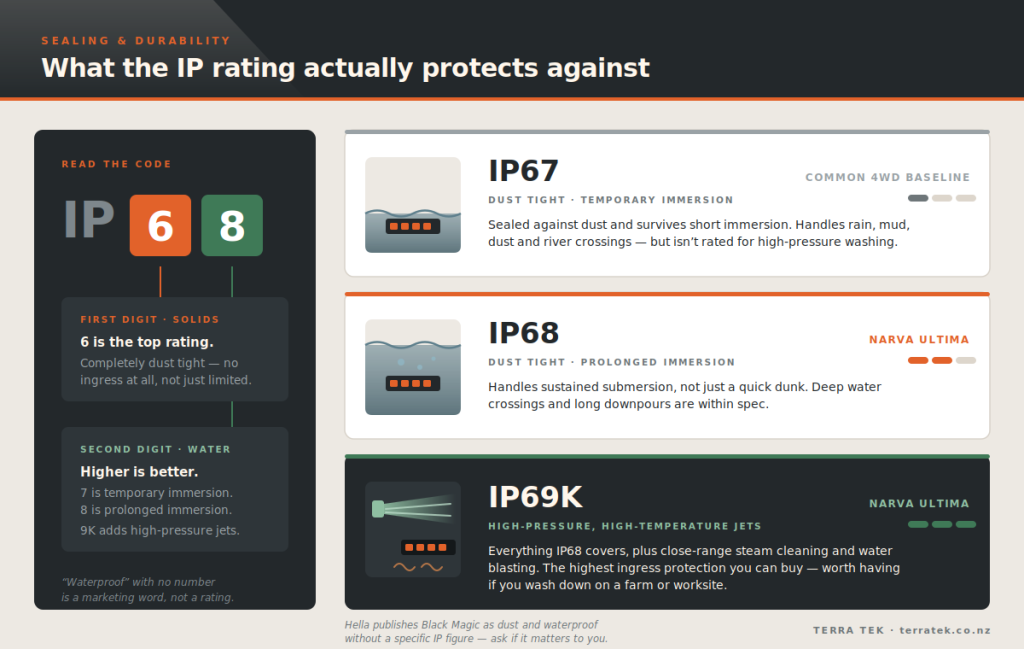
The Narva Ultima range carries IP68 and IP69K. The Hella Black Magic range is described as dust and waterproof; ask for the specific rating if it matters to you.
Single row versus dual row
Dual row packs more LEDs into a shorter bar. The 21.5-inch Hella dual row runs 40 LEDs, versus 21 LEDs in the 20-inch single row — nearly double the LED count in a similar length. Dual row bars are taller, catch more wind, and can be harder to fit behind a bar or under a roofline.
Warranty
This is the most under-weighted spec in the category and it explains most of the price gap.
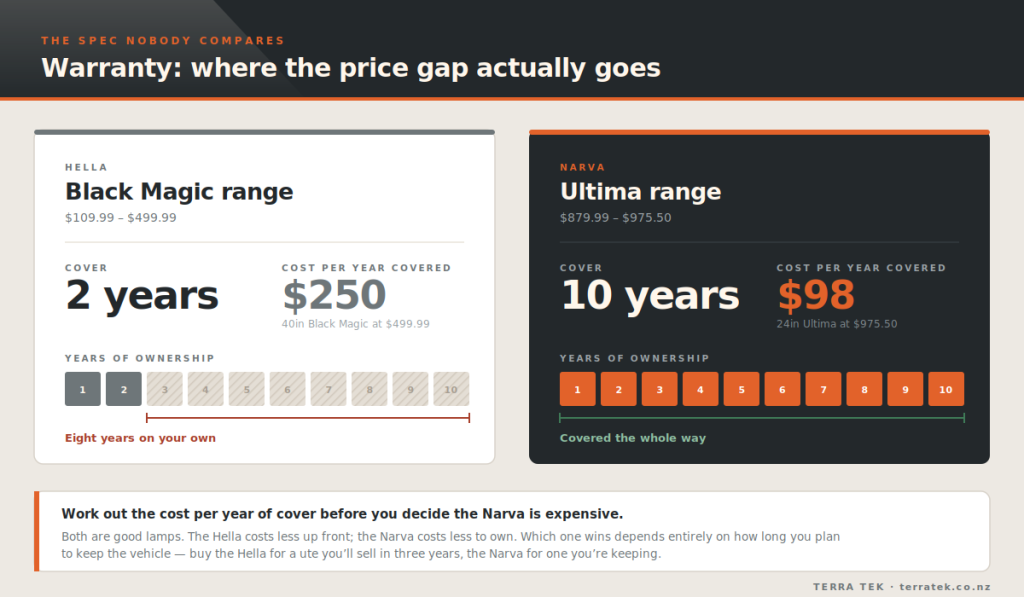
- Hella Black Magic: 2 years
- Narva Ultima: 10 years
Over a decade of ownership, a 10-year warranty on a $975 bar is a very different proposition to 2 years on a $499 bar.
Connectors and wiring
Narva Ultima bars include an integrated DT connector with a patch harness, and support an optional Connect+Control panel for beam shape and output control. Hella Black Magic bars come with a 2m cable, which is enough to reach bumper or roof rack mounting points on most vehicles.
Comparison: every led light bar we stock
| Model | Size | LEDs | Output | Beam | IP rating | Warranty | Price |
|---|---|---|---|---|---|---|---|
| HellaBlack Magic Mini | 6.2 in | 6 | 1,600 lm up to 100m range |
Flood | Dust & water resistant | 2 years | $109.99 |
| HellaBlack Magic Mini | 6.2 in | 6 | 1,600 lm up to 100m range |
Spot | Dust & water resistant | 2 years | $109.99 |
| HellaBlack Magic | 20 in | 21 | 6,000 lm up to 595m range |
Spot | Dust & water resistant | 2 years | $299.99 |
| HellaBlack Magic Dual Row | 21.5 in | 40 | 11,000 lm up to 595m range |
Combi — driving + flood | Dust & water resistant | 2 years | $429.99 |
| HellaBlack Magic | 40 in | 42 | 12,000 lm up to 595m range |
Spot | Dust & water resistant | 2 years | $499.99 |
| NarvaUltima (pair) | 8 in | 15 × 9W Osram | 20,400 raw / 13,220 effective 50m width at 450m |
Long & wide hybrid | IP68 / IP69K | 10 years | $879.99 |
| NarvaUltima Satin | 24 in | 38 × 9W Osram | 25,840 raw / 16,450 effective 65m width at 600m |
Long & wide hybrid | IP68 / IP69K | 10 years | $975.50 |
| NarvaUltima Black + trims | 24 in | 38 × 9W Osram | 25,840 raw / 16,450 effective 65m width at 600m |
Long & wide hybrid | IP68 / IP69K | 10 years | $975.50 |
Swipe the table sideways to see all columns.
All prices include GST. Free shipping on orders over $100.
Our picks by use case
Best all-round touring led light bar – Narva Ultima 24 inch ($975.50)
The strongest beam data in the range at 65m of width at 600m, IP68/IP69K sealing, pressure die-cast aluminium housing, a UV-resistant hard-coated polycarbonate lens that won’t yellow, and vibration resistance meeting heavy vehicle standards. The 10-year warranty is the real argument. Available in satin, or black with interchangeable colour trims at the same price.
Best value large led light bar – Hella Black Magic 40 inch ($499.99)
Half the price of the Narva with 595m of beam range and integrated thermal sensors that prevent overheating and actually lift output in cold conditions. The 2m cable reaches most mounting points. You’re trading warranty length and published beam-spread data for a considerably lower price.
Buy the Hella Black Magic 40 inch
Best led light bars for tight mounting – Hella Black Magic Dual Row 21.5 inch ($429.99)
Forty LEDs in a 21.5-inch package. If you want serious LED count but don’t have the frontage for a 40-inch bar, this is the compromise. Taller profile than a single row, so check clearance.
Buy the Hella Black Magic Duel Row
Best small led light bar – Hella Black Magic Mini 6.2 inch ($109.99)
Six LEDs, upright or pendant mounting, blackout finish. Choose flood for camp lighting, reversing and close-in work, or spot for distance. Cheapest way into the range and easy to add in pairs.
Buy the Hella Black Magic Mini
Worth knowing: the 8-inch Ultima ships as a pair ($879.99)
Two lamps, 13,220 effective lumens combined, 50m of width at 450m, IP68/IP69K, 10-year warranty. Because they’re supplied as a pair, they’re the only option in the range that could potentially satisfy the pairing requirement for a headlamp fitment — provided the lamps carry an approved standards marking and the aim, dipping and dazzle requirements are met. Check the lens markings and confirm with your WOF inspector before wiring them as main beams.
Buy the NARVA 8 inch Ultima Pair
led light bar Installation and wiring
Tools
Driving light harness, voltage meter, wire strippers, screwdriver, wire connectors, electrical tape.
Do this first
Bench test everything before you drill. Connect the bar up and confirm it works before it’s mounted and half the loom is run.
Disconnect the battery. Use insulated tools and wear gloves. Vehicle electrical systems will bite.
Choose a strong mounting point — bull bar, driving light mount, or roof rack. Check the aim requirement before you commit: the beam centre must point horizontally or down, and to the centre or left.
Wiring: the part that decides your WOF
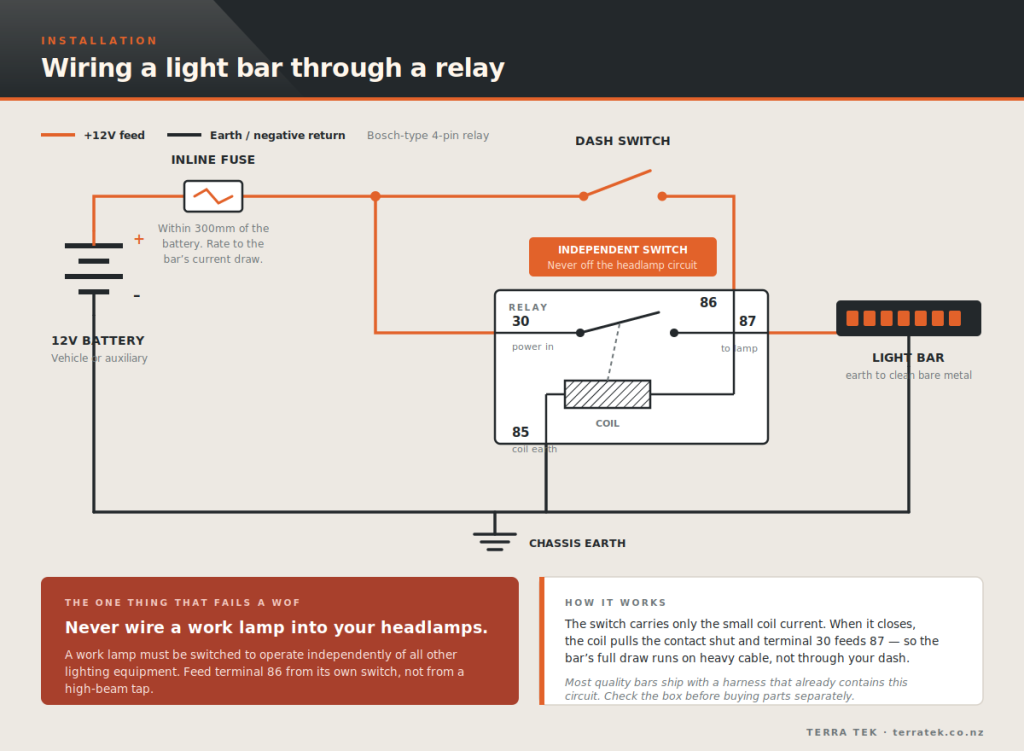
If you’re fitting the bar as a work lamp — which covers most installations — it must be switched independently of all other lighting equipment and must not be wired into the headlamp circuit. This is not a style preference. Wiring a non-compliant bar into your high beams is what turns a pass into a fail.
If you’re fitting a standards-marked pair as main beams, they must still be able to be dipped or extinguished from the driver’s seat.
Do I need a relay?
Yes, in almost all cases. A relay lets a low-current switch control the high-current circuit the bar draws, so your dash switch isn’t carrying the full load. Many quality bars ship with a harness that already includes a relay and an inline fuse — the Narva Ultima range includes an integrated DT connector with a patch harness. Check what’s in the box before buying a separate kit.
Shop wiring kits and harnesses
Maintenance
Clean with a soft brush or sponge and a mild cleaning solution. Check the IP rating before you point a pressure washer at anything — IP69K rated lamps handle high-pressure jets, lower-rated ones may not. Inspect connectors and mounting bolts periodically; vibration is what kills most installs, not the LEDs.
led light bars Frequently asked questions
Are LED light bars legal in New Zealand?
Yes, they’re legal to fit. Whether you can use one while driving depends on how it’s classified. A light bar can only be a headlamp if it’s fitted as a pair and carries an approved E-mark, e-mark or DOT marking. Otherwise it’s a work lamp, which must be switched independently of your other lights and may only be used when the vehicle is stationary or travelling slowly to illuminate a work area.
Will a light bar fail my WOF?
Not if it’s fitted correctly. A non-compliant light bar that’s wired into the headlamps and doesn’t meet the work lamp criteria must be failed. The same bar on an independent switch, not wired into the headlamps, can be classified as a work lamp and pass.
Can I use my light bar on the open road?
Only if it’s fitted as a compliant, standards-marked pair operating as main-beam headlamps. If it’s a work lamp, using it for normal on-road driving is illegal.
How do I know if my light bar is standards compliant?
Check the lens for markings. A circle with a capital “E” and a number, a rectangle with a lowercase “e” and a number, or the letters “DOT”. If there are no markings, it’s likely non-compliant — NZTA states it isn’t aware of any compliant light bars without markings on the market.
Is there a lumen limit for light bars in NZ?
NZTA’s technical bulletin doesn’t set one. Compliance turns on standards markings, pairing, aim, independent switching, and not dazzling other road users.
Do I need a relay for my LED light bar?
Almost always. A relay lets a low-current switch control the bar’s high-current draw. Check whether your bar ships with a harness that already includes one.
Single row or dual row?
Dual row fits more LEDs into a shorter bar but sits taller and catches more wind. Single row is easier to mount and generally cleaner aerodynamically.
What’s the difference between raw and effective lumens?
Raw lumens is the theoretical LED chip output. Effective lumens is what actually leaves the lamp after optical losses — typically 35–40% lower. Always compare like with like.
Related guides and gear
- 4×4 spotlights and driving lamps — for distance where a bar won’t fit
- LED work lights — flood beams for camp, worksite and reversing
- LED tail lights — trailer and vehicle rear lighting
- DC-DC chargers and battery management — powering an off-grid setup
- Anderson plugs — high-current connections done properly
- CB and UHF radios — staying in touch beyond mobile coverage
Sources
- NZTA Technical Bulletin 14: LED light bars — VIRM: In-service certification (WoF and CoF)
- Land Transport Rule: Vehicle Lighting 2004
- Manufacturer specifications: Hella, Narva
This guide is general information, not certification advice. Confirm your specific setup with your WOF inspector or inspecting organisation before relying on it.